
Digital experience
The internet is being rewritten. What happens to your brand voice?

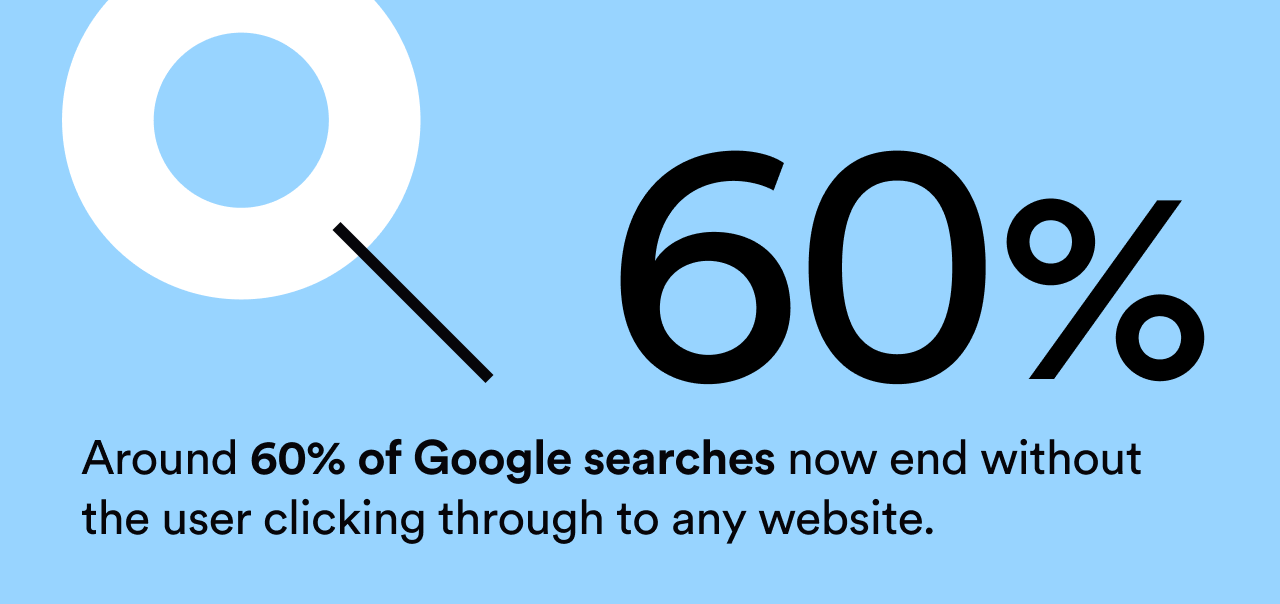
If predictions around AI search are right, text is no longer the final product. It’s the raw material. Increasingly, AI systems read, interpret, and rewrite what brands publish, turning carefully crafted pages into short summaries, answers, and recommendations delivered somewhere else entirely. This isn’t a prediction. It’s already measurable. Around 60% of Google searches now end without anyone clicking through to a website. When AI Overviews appear on a search results page, click-through rates for the top-ranking result drop by 58%. Your content is being consumed, but just not on your terms.
That changes things.
Because while machines are excellent at extracting meaning, they’re still terrible at preserving emotion, nuance, and personality. Tone gets flattened. Voice gets neutralised. And the risk is that brands start to sound… the same.
So the question isn’t just “will people still visit my website?” it’s “when AI speaks for you, will anyone still recognise your brand?” And does it even matter?
Discovery versus differentiation
This tension already exists, but AI has certainly accelerated it.
On one side, brands need to be discoverable: clear, structured, semantically sound, answer-led content. Content that AI systems can easily parse, trust, and reuse.
On the other hand, brands still need to stand out: to feel human, distinctive, emotionally resonant. To be remembered.
The scale of the shift is hard to overstate. Over a third of generative AI users say they’ve started replacing traditional search with AI assistants for some of their queries. Organic click-through rates have fallen 61% for queries where AI Overviews appear. This isn’t a niche trend among early adopters. It’s a behavioural shift happening across demographics.
Historically, words carried much of the weight of brand differentiation. In an AI-mediated world, would this still be the case?
What actually carries brand now
When text becomes summarised, what remains intact?
Visual identity. Design systems. Motion, layout, rhythm. Imagery, film, sound. The feeling of moving through a brand world.
These are harder to compress. Harder to rewrite. Harder to abstract.
And the data supports this instinct. Research consistently shows that 55% of a brand’s first impression is visual. A signature colour can increase brand recognition by up to 80%, and consumers are 81% more likely to recall a brand’s colour than remember its name. When AI strips your words back to bare information, these visual and sensory signals are what people actually carry with them.
That’s why we’ll likely see brands leaning more heavily on video, audio, and design-led experiences, and possibly even a resurgence of above-the-line advertising to build memory and meaning outside search entirely.
Trust, credibility, and familiarity will become even stronger signals than clever copy.
So what happens to the website?
The website doesn’t disappear, but its role changes.
Consider: zero-click searches rose from 56% to 69% between May 2024 and May 2025. If nearly seven in 10 searches never reach your site, the visits that do land there carry far more weight. Every page becomes a conversion opportunity, not a browsing experience.
The website becomes a source of truth for machines, a destination for humans, and a conversion environment, and not a discovery engine.
People will still land on sites, but often after an AI has already framed the brand for them. When they do, the experience needs to confirm what they’ve been told, build confidence quickly, and guide them clearly.
This is where structure, usability, and performance matter just as much as creativity.
And quite possibly, this is where headless and composable approaches start to make more sense by separating content value from presentation value:
To develop one content system serving multiple audiences (LLMs included), with a front end designed unapologetically for people.
- For machines: structured text, clear hierarchy, explicit relationships, metadata-rich content.
- For humans: design-led journeys, strong visual identity, emotional pacing, confidence-building UX.
This is not “SEO vs design.”
It’s systems thinking.
What this means for Everything Connected
In this landscape, we aren’t just building websites.
We’re protecting brand integrity in machine-mediated journeys. Designing systems that balance clarity with character. Ensuring creativity doesn’t get stripped out in the name of optimisation. Helping brands remain recognisable even when their words are paraphrased.
We’re developing and supporting content strategies by building structured sites with semantic frameworks that give meaning to machines as well as humans.
Brands with consistent presentation are 3.5 times more visible, and those maintaining that consistency see revenue grow by up to 23%. In a world where AI is constantly rewriting and reframing, that consistency isn’t a nice-to-have. It’s commercial infrastructure.
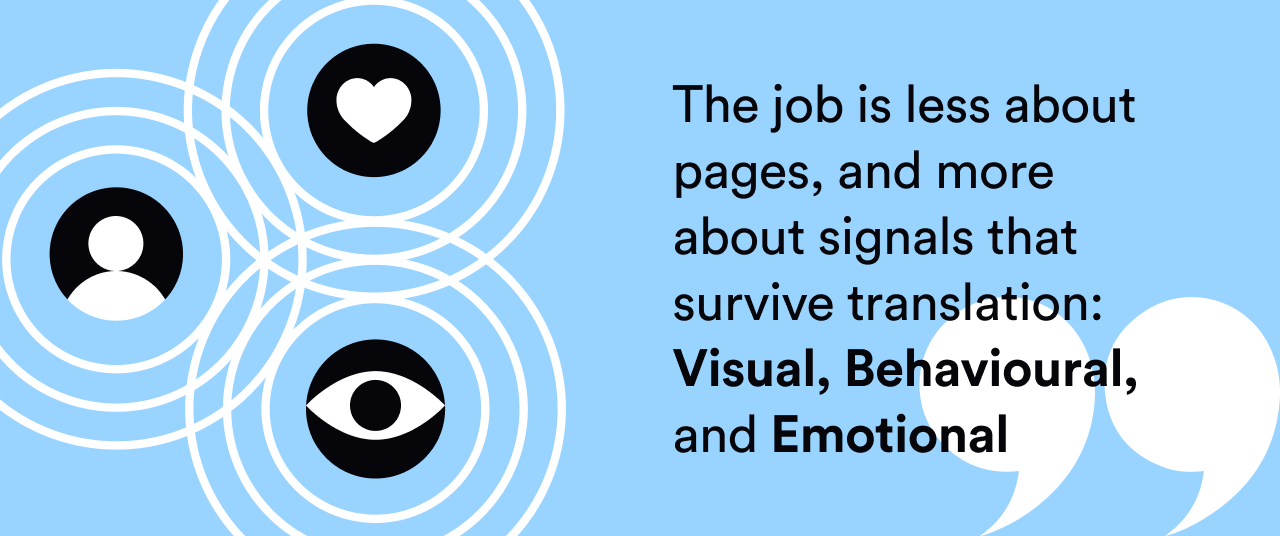
The job becomes less about pages, and more about the signals that survive translation:
- Visual
- Behavioural
- Emotional
Where DXO fits into all of this
Digital Experience Optimisation isn’t about chasing algorithms. It’s about removing friction, reinforcing trust, and making sure every interaction works harder, regardless of where it starts.
In an uncertain future, DXO is how brands stay usable as discovery fragments, stay credible as journeys compress, and stay distinctive when language gets flattened.
You can’t future-proof everything. But you can design experiences that hold up when the rules change.
And right now, they are.
If AI is already reshaping how your brand gets discovered, your website needs to work harder when people arrive. That's where our Digital Experience Optimisation approach comes in. Talk to us about building experiences that hold up when the rules change.